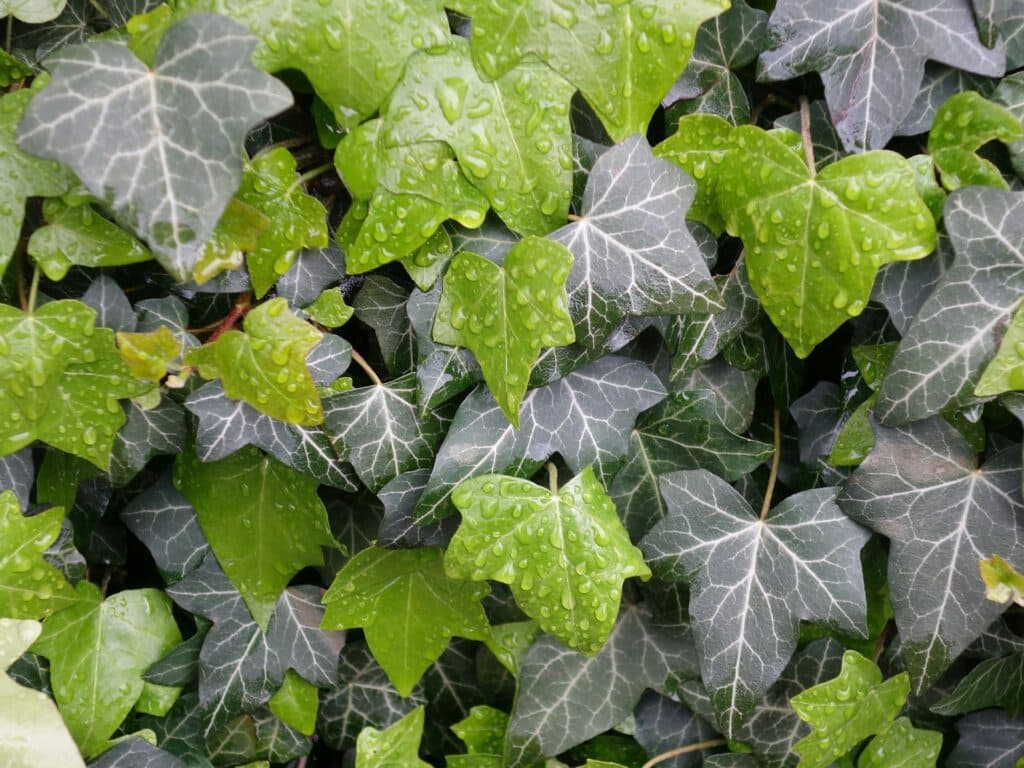
Ivy, the evergreen climbing plant. Some people see it as a nuisance, while others love nothing more than a healthy ivy with thick vines. It’s clear that ivy requires maintenance, but what plant doesn’t?In this blog, we’ll explore the benefits of ivy in the garden.
Ivy, the evergreen climbing plant. Some people see it as a nuisance, while others love nothing more than a healthy ivy with thick vines. It’s clear that ivy requires maintenance, but what plant doesn’t?In this blog, we’ll explore the benefits of ivy in the garden.
Benefits of Ivy
1. Green All Year Round
A garden with ivy is guaranteed to stay green all year round. That’s because ivy doesn’t shed its leaves en masse, as deciduous trees do. In winter, ivy is just as green as it is in summer. And green—that makes most people happy. Research shows that people in green surroundings are less likely to become depressed. So that’s the first benefit: ivy is always green, and that has a positive effect on our well-being.
2. Ivy provides insulation
The second benefit also benefits the owner of the ivy—at least, if the ivy is growing up the wall. In that case, the ivy acts as extra insulation. The cold wind is blocked by the ivy, so the wall cools down more slowly. And in the summer, the green foliage keeps the blazing sunlight off the wall, keeping it much cooler.
3. Insects Benefit Greatly
But ivy is also a great garden plant for biodiversity. A tremendous number of insects benefit from ivy. You could even say that ivy is a lifeline for many insects. That’s because ivy blooms well into winter. And during that time, it’s often the only plant in bloom—and thus the only food source for insects. Early in the fall, butterflies such as the peacock butterfly, the red admiral, and the small tortoiseshell are drawn to ivy. Moths also appreciate the nectar from ivy.
By the way, did you know that there’s also a species of bee that lives almost exclusively on ivy? That bee is aptly named the ivy bee, and you can find it in the Field Guide to Bees of the Netherlands and Flanders. By the way, you can also use ivy as a ground cover. This helps prevent the soil from drying out and is good for insects and other invertebrates that live in the soil. But amphibians and hedgehogs also enjoy a green ground cover.
4. A Magnet for Birds
Thick ivy also acts as a magnet for birds—the fourth benefit. Blackbirds, song thrushes, blackcaps, and robins all appreciate the dark berries of the ivy. And would you like to attract house sparrows to your garden? Then ivy is also a good choice. The thicker the ivy, the greater the chance of attracting house sparrows to your garden. House sparrows prefer to hide among branches and leaves. You get the idea: thick ivy is perfect for that. And blackbirds and song thrushes nest among the vines of thick ivy. If you hang a birdhouse among the ivy, you might even attract a great tit or a blue tit.